Showing posts with label nutrition. Show all posts

Wednesday, February 10, 2021

For Well-Being and Happiness, Focus on Self-Love


Valentine's Day is almost here! This year I hope you give kindness and compassion to someone worthy of your attention. You.

Science is clear that self-love and self-care are critical to well-being and happiness. People who value themselves are more likely to engage in healthy behaviors, have better health, and higher satisfaction in relationships. 

One study, published in Clinical Psychological Science, showed people who focused on self-compassion had lower heart rates and sweat responses compared to those with critical thoughts about themselves. Study author, Dr. Hans Kirschner, explained the results, "These findings suggest that being kind to oneself switches off the threat response and puts the body in a state of safety and relaxation that is important for regeneration and healing." 

Despite the many benefits, I've discovered two common beliefs that hold women back from practicing self-love and self-care:

Belief #1. Self-care is selfish.  

My response: You become better in all of your roles and relationships when you are healthy and happy. In addition, you model the importance of physical and mental self-care to your loved ones. Win-win!

Belief #2. If I accept and love myself and my current body, I will become complacent and won't be motivated to make changes.

My response: 28 years of education and experience have shown me the the opposite! Shame and an "I-hate-my-body" attitude do not motivate positive change and instead reinforce negative behaviors. 

So what does self-love and self-care look like? Well, it does NOT look like dieting, deprivation, or counting calories or grams! That's not love! Instead, it looks like:

  • Valuing your well-being and happiness.
  • Setting healthy boundaries with others. 
  • Talking to yourself with kindness and compassion.
  • Caring for your here-and-now body with respect.
  • Listening to your body's signals (like hunger and satiety). 
  • Eating nourishing foods and eating foods that bring you pleasure.
  • Getting adequate rest and sleep.
  • Frequent joyful movement.
  • Forgiving yourself for past mistakes.
  • Managing your stress in healthy ways.
  • Surrounding yourself with people who lift you higher.
  • Spending time in nature.
  • Participating in activities that bring you joy.
  • Living your values and speaking your truth.
  • Acknowledging that self-love is a journey.
This Valentine's Day and beyond, please give yourself some love!  

💗💗💗

I help women move beyond dieting and overwhelm, toward their passions and purpose. Email me at kathianne.williams(at)gmail.com, to learn more. Clients who start before the new Nourish.Create.Bloom. website launches on April 1st will receive a discount.

Monday, October 26, 2020

Healthy Living: My WebMD Debut

Happiness, connection, time outside, and enjoyable
movement are all important parts of healthy living.
Photo by Brian H. Williams


Earlier this year, I was disheartened to find my debut WebMD article (I was not the author but was cited as an expert), was replaced on their site. It was a highlight of my career at the time when WebMD interviewed me. Twice! And although I did the interview at least three years after my wedding, I remember when I read the article I was thinking, Who is this Williams? 😆 

Luckily, I was able to easily find multiple pilfered copies of the article by googling my name plus WebMD. Since my previous links will no longer work, I copied the original version and pasted it below. I'm not sure of the exact date the article was written, but it's between 2008-2010, when I was living in Atlanta. It's all still relevant* and encompasses many aspects of well-being. You can find my insights in steps 1, 3, 4, and 5. Enjoy!

*Note: If I were the author of this article, I would not include "Gauge Your Girth" in Step 1. I'll write a blog post about my reasoning in the near future and link it back here. 

Healthy Living: 8 Steps To Take Today

Here’s your checklist of practical healthy living tips that are ready to go. Let’s get started.

Healthy Living Step No. 1: Take stock.

Your first step toward healthy living is to get a handle on your health status right now. Here’s your to-do list:

  • Make appointments with your doctor and dentist. Catch up on your routine screening and immunizations, and take the opportunity to ask your doctor any questions you might have.
  • Gauge your girth. Measure your height and weight to check your BMI, and measure your waist circumference to see if you’re overweight and if your waistline is putting your health at risk.
  • Assess your activity. How much physical activity do you get in a typical week? How intense is that activity? How much variety do you get in your activity, and how much do you enjoy it? The CDC recommends that adults get at least two and a half hours per week of moderate-intensity aerobic activity or one hour and 15 minutes per week of vigorous-intensity aerobic activity, plus muscle-strengthening activities at least two days per week.
  • Keep a food diary. Write down everything you eat for a day — and no fair skipping the items you’re embarrassed about. “The idea is to write it down … without judgment,” says Kathianne Sellers Williams, MEd, RD, LD, a nutritionist, wellness coach, and personal trainer in Atlanta. “You can’t change what you’re not aware of or don’t acknowledge.”
  • Check your mood and energy. Healthy living includes emotional wellness and adequate rest. How has your mood been lately? Are you experiencing any symptoms of depression or anxiety? Do you usually sleep well for seven to eight hours a night?
  • Consider your social network. How strong are your connections with family and friends? Are you plugged in with social or spiritual groups that enrich your life? “People have a fundamental need for positive and lasting relationships,” C. Nathan DeWall, assistant professor of psychology at the University of Kentucky, tells WebMD.

If you’re not thrilled with the answers to some of those questions, remember that the point is to figure out where you are today so you can set your healthy living goals. It’s not about being “good” or “bad,” “right” or “wrong.”

Healthy Living Step No. 2: Put out fires.

If you know that you have chronic health problems, whether it’s heart disease, diabetes, depression, arthritis, or other conditions, treatment is an obvious priority for healthy living. The same goes for risky behaviors, such as smoking, and addictions of any kind.

Addressing these issues typically isn’t a do-it-yourself task. Partner with your doctor. Make the phone call today to schedule that appointment. 

Healthy Living Step No. 3: Move more.

  • Make it fun. Go on a hike, walk with friends, take a bellydancing or karate class, or whatever you enjoy. “There’s no need to stick to cardioequipment in the gym if you’re dreading it and you don’t like it,” Williams says. “Find something that’s fun.”
  • Keep track of it. Make a note of your physical activity in your date book or calendar. “Put big Xs on the days that you exercise,” Williams says. “Keep a visual record that you look at frequently” as a reminder and motivator.
  • Set a weekly goal for activity. To build your confidence, “make the first goal so easy that you say, ‘I know I can do that,'” Williams suggests. She recommends weekly goals because if you set a daily goal and miss a day, you might get discouraged; weekly goals give you more day-to-day flexibility. And at the end of the week, reward yourself with a visual reminder of your accomplishment, such as buying flowers for yourself.
  • Work activity into your day. “Ten percent of something is better than 100% of nothing. So even if you have 10 minutes, it’s better than zero minutes,” Williams says. She suggests taking a 10-minute walk before lunch or walking up and down the stairs when you’re feeling drained and tired.

Other ideas include wearing a pedometer to track how many steps you take per day (health experts recommend shooting for 10,000 steps per day) and working with a personal trainer (double up with a friend to lower the cost) to create an exercise routine.

Healthy Living Step No. 4: Upgrade your diet.

Williams, a nutritionist for a dozen years, says her diet advice isn’t about eating certain foods and avoiding others as much as it is about awareness and choices. Here are her pointers:

  • Replace “I should” with “I choose.” So instead of “I should be eating more fruits and vegetables,” it’s “I choose to eat more fruits and vegetables” or “I choose not to,” because it’s more powerful language,” Williams says. “It shows that you’re in control, you’re making the choice. So if you choose to or you choose not to, you make the choice and you move on.”
  • Skip the guilt. “Usually, whenever someone feels guilty about something, it feeds right back to the behavior that they’re trying to get rid of,” Williams says. “So if someone is an emotional eater and they say, ‘I know I shouldn’t be doing this,” it implies more guilt and judgment on themselves, they feel worse, and then they end up eating to comfort themselves.”
  • Choose to plan. Stock your pantry with healthy fare and bring healthy snacks with you so you’re prepared when you get hungry. “When we’re really hungry, our physiology kicks in and that’s when we’re craving the hamburger and fries; we’re not craving a salad,” Williams says.
  • Slow down and savor your food. Don’t watch TV, work, or drive while you’re eating. “A lot of people tell me, ‘My problem is that I really like food,’ but I think that’s a really good thing,” Williams says. “If you really enjoy food, sit down and enjoy your meal. You’re much more likely to feel psychologically satisfied if you don’t multitask while you’re eating.”
  • Shoot for five to nine daily servings of varied fruits and vegetables. Cover the rainbow of fruit and vegetable colors to get a good mix of nutrients. “If you’re not getting the rainbow, you’re probably not getting all the nutrients that you need,” Williams says.

Healthy Living Step No. 5: Manage stress.

  • Routine maintenance: Develop positive coping skills, such as meditation and visualization, and look for activities, such as yoga or exercise, to keep your baseline stress level in check.
  • Breakthrough stress: Find ways to handle stressful situations that flare up without warning. For instance, Williams says that after a stressful meeting at work, you might run up and down the stairs a few times to burn off anger, or retreat to a bathroom stall to take a few deep breaths and refocus.
  • Check your perspective. Ask yourself, “Will this matter to me a year from now?” If not, why are you getting so wound up?
  • Volunteer. Helping to meet other peoples’ needs may make your own problems seem smaller.
  • Keep a gratitude journal. Write down the positive people, events, and things that you’re thankful for. “It really switches the focus to, ‘Wow, look how much I have,” Williams says. “Most stress is caused by wishing things were different than they are now.”
  • Breathe. One of the breathing exercises that Williams recommends is to count your breaths for a minute, and then try to cut that number of breaths in half for the next minute.
Healthy Living Step No. 6: Sleep better.

If you have trouble sleeping, try these tips from sleep medicine specialist Lisa Shives, MD, medical director of Northshore Sleep Medicine in Evanston, Ill.

  • No TV or computer two hours before bedtime. It’s not just because the TV and computer are stimulating; it’s also because of their light. “We’re very sensitive to the cue that light gives you that it’s time to be up and about,” Shives says. She recommends light, calming reading lit by a lamp that doesn’t shine directly into your eyes.
  • No heavy exercise close to bedtime. Light stretching is OK, but vigorous activity will heat up your body’s core temperature, which makes it harder to sleep. “If you’re working up a sweat, you’re working too hard right before bed,” Shives says.
  • Take a hot bath. That will heat up your core body temperature, but when you get out of the bath, your core temperature will fall, which may help you get to sleep. Plus, the bath “relaxes you mentally,” Shives says. She adds that having a hot, noncaffeinated drink, such as chamomile tea, may also help.
  • Set a regular sleep schedule. When Shives treats insomnia patients, she tells them that although they can’t make themselves fall asleep, they can make themselves get up at a certain time the next morning. And though they may be tired at first, if they don’t nap, they may start sleeping better during the following nights. “We’re going to get nowhere if they take big naps during the day and keep a very erratic sleep schedule; it’s chaos then,” Shives says.
  • Don’t count on weekend catch-up sleep. If you have chronic sleep problems, you probably can’t make up for that on the weekends. But if you generally sleep well and have a rough week, go ahead and sleep in on the weekend. “I actually think that’s good for the body,” Shives says.
  • Don’t ignore chronic sleep problems. “Don’t let sleep troubles linger for months or years. Get to a sleep specialist earlier rather than later, before bad habits set in,” Shives says.
  • Prioritize good sleep. “This is as important as diet and exercise,” Shives says. She says that in our society, “we disdain sleep, we admire energy and hard work and [have] this notion that sleep is just something that gets in the way.”
Healthy Living Step No. 7: Improve your relationships.

Healthy living isn’t just about your personal habits for, say, diet and activity. It’s also about your connections with other people — your social network.

DeWall, the University of Kentucky social psychologist, offers these tips for broadening your social network:

  • Look for people like you. The details of their lives don’t have to match yours, but look for a similar level of openness. “What really is important in terms of promoting relationship well-being is that you share a similar level of comfort in getting close to people,” DeWall says. For instance, he says that someone who needs a lot of reassurance might not find the best relationship with someone who’s more standoffish. “Feel people out in terms of, ‘Does this person seem like me in terms of wanting to be close to other people?'” DeWall suggests.
  • Spend time with people. “There’s this emphasis in our culture that you need to be very independent — an army of one, you can get along on your own,” DeWall says. “Most people don’t know their neighbors as much as they did 50 or 60 years ago.”
  • Build both virtual and face-to-face relationships. DeWall isn’t against having online connections to other people. “But I think long term, having all of your relationships online or virtual … would probably be something that wouldn’t be as beneficial as having a mix” of having virtual and in-person relationships.
  • If a close relationship is painful, get help. “Some of my work and some work that other people are doing suggest that … when you feel rejected by someone, that your body actually registers it as pain. So if I’m in a relationship that’s really causing me a lot of pain, then we need to do something, we need to go and seek help,” DeWall says.
Healthy Living Step No. 8: Challenge your mind.

Participating in mentally stimulating activities, especially activities that involve other people, may be good for the brain.

There’s no downside to including brain-challenging activities as part of your healthy living, unless “you spent $400 on some computer program that makes all sorts of wild claims about brain health,” says David Knopman, MD, a neurologist at the Mayo Clinic in Rochester, Minn.

Knopman explains that brain fitness is influenced by many factors, including education and opportunities for mentally stimulating activities starting in childhood, and also by the presence or absence of depression, diabetes, smoking, high blood pressure, and other risks.

Observational studies have shown that people who engage in mentally stimulating activities may be less likely to develop dementia. But Knopman notes that such studies don’t prove cause and effect, so it’s not clear if mentally stimulating activities protect against dementia or whether people with healthier brains are drawn to those activities in the first place.

That said, Knopman says, “I think that socially engaging activities are particularly important, and that’s why I’m somewhat skeptical about the various commercial entities that seek to sell computer games to stimulate the brain. … If that’s done to the exclusion of socially engaging activity, it’s probably counterproductive.”

*****

Article originally posted at https://www.webmd.com/balance/features/healthy-living-8-steps-to-take-today#1

Wednesday, July 12, 2017

Nourishing Beauty

With Emily in 2011
As a dietitian and health educator, I know how important it is to nourish ourselves with whole foods. That includes limiting our intake of pesticides (especially from the Environmental Working Group's Dirty Dozen) and other dubious “ingredients” like BPA from food packaging. I know quite a few health-conscious mamas who focus on putting healthy foods in their families mouths and end up covering them in toxins anyway. All summer long we slather ourselves and our children in sunscreen to protect them from harmful UV rays while inadvertently exposing them to harmful chemicals. And it’s not just sunscreens, it’s other hair and skin care products as well.  Even some specifically advertised as formulated for children.  

Did you know your skin is like a second mouth? In fact, a debatable percentage of what you put onto your skin gets absorbed into your body. Don’t believe me? Think about medicines that are delivered via skin patches. In addition, people inhale powders and sprays and orally ingest products that are applied to lips and hands.


This topic is not my area of expertise, so I’m introducing you to someone who knows a lot more about this topic. NCB readers, meet Emily Toledo, my crafty soul sister, tribes-woman, and one of my child’s Godmothers (that’s how much I love and trust her!) Emily has spent countless hours researching and has become a passionate advocate for women and children in the process. On her journey, she joined the company, Beautycounter, so she could spread the word and help others. Beautycounter also helps nourish her own sweet family by providing income so she can be home with her littles.


Emily Toledo

Here is my interview with Emily:


KSW: Hi Dear Emily! I’m excited to introduce you and your mission for safer beauty to my NCB readers. Can you tell us why you felt drawn to this cause and how got involved with Beautycounter?
ET: When our son was 2 years old, he had a severe allergic reaction to a very well known brand (children’s formula) of sunscreen. I rushed him to the pediatrician who reassured me that it was just an allergic reaction, quickly told me that children are particularly vulnerable to what we put on their skin, and advised me to just buy a different brand.  At the time, I was buying organic food, shopping at the local farmers market, making my own cleaning products, had reduced our use of plastic in the house, etc. I thought I was ahead of the game! Yet, I had never considered what ingredients were in the products I was using on myself and on my family. The experience served as a Pandora’s Box moment for me and was my catalyst for discovering Beautycounter. That was 2 ½ years ago and educating people on this issue of ingredient safety and empowering them to make safer choices has become my absolute passion.
KSW: I’ve seen you post some pretty crazy/ scary #s about the lack of regulation in the United States vs. Europe. Can you tell my readers a few of these?
ET: Sadly, the United States lags behind other countries in terms of consumer protection. While the European Union restricts nearly 1,400 ingredients from use in products, the United States restricts only 30. The last time a major federal law was passed regulating the personal care and cosmetics industry was 1938. Since then, more than 80,000 chemicals have been introduced into commerce. Approximately, 12,000 of those chemicals are used in the personal care industry and only 10% have been tested for safety. Of the chemicals we actually DO have data on, many of them have proven links to human health issues such as contact dermatitis, endocrine disruption, and cancer.

It is perfectly legal for a company to manufacture and sell a product without disclosing that it contains ingredients known to be harmful for human health. Several major brands actually have safer formulas sold in Europe that are not sold in the U.S. Even worse, due to major loopholes in federal law, cosmetics can be labeled “all-natural” and “organic” without containing ingredients that accurately meet those descriptions. In fact, products certified as "organic" can contain as little as 10% total organic ingredients. Tricking consumers into thinking they are getting a safe product with a clever marketing campaign is so common that it has its own term - “greenwashing” - and it’s rampant in the personal care and cosmetics industry.
KSW: Tell us about Beautycounter's current efforts for stricter legislation.
ET: Our advocacy work is what truly sets Beautycounter apart from any other brand. We are not only creating safer products and being a part of the solution, but we’re also fighting for legislative change so that one day, all products will be held to the same standard of safety. In 2015 for example, we partnered with the Oregon Environmental Council and were instrumental in helping pass the Toxic Free Kids Act. We are currently working with several other states (California and Hawaii, to name a few) to help draft similar laws to ensure safer products in the marketplace.
You can join the fight too! Text "better beauty" to 52886 and follow the prompts to urge your senator to pass more health protective laws.
KSW: How can people follow you (on FB, Pinterest, etc) to get more information and get updates?
ET: I love sharing updates on the industry, announcing new products when they launch and discussing strategies for healthy living, in general.  My Facebook and Instagram accounts celebrate this! You can find me online:
KSW: Is there anything else you would like to tell NCB readers?
ET: It doesn’t matter if a company claims to be “safe", “pure” or “natural”. In such an unregulated industry, words like that have little meaning. You need to be your own advocate and read the ingredients. A helpful tool for consumers is Environmental Working Group's “Healthy Living” app. It’s available (and FREE) on iPhone and Android. You can use the camera on your phone to scan the barcode of products in your home (or before buying them in the store) to see how they rank in terms of safety.

 I want to introduce everyone to Beautycounter’s "Never List". These are the ingredients that will never be used in the products. Ever. Many are cancer causing agents, skin irritants, or are endocrine disruptors. Even if you’re not ready to make changes to your personal care & cosmetics regimen, I encourage you to compare the Never List with the ingredients in your products. Knowledge is power!

Hey Readers, I want you to know that I’m writing about this because I believe in this cause as well. I’m not getting any free products by writing this! 
I also want you to know that you can make your own products as well. I use olive and almond oil on my skin, and have put these and essential oils into coarse sugar to make a sugar scrub. These are functional and fun to make, but they don’t have the amazing scent of BC oils and feel heavier and greasier than the BC products. I tend to rebel against recipes (I cook, make art, and make body scrubs by throwing things together and hoping for the best- which amazingly works out most of the time) but you may want to find body care recipes online if that is your schtick.  

Fabulous Resources
The Environmental Working Group www.ewg.org
Campaign for Safe Cosmetics www.safecosmetics.org
*Check out the Red Lists of concerning chemicals found in cosmetics and other body care products

Monday, September 1, 2014

Mid-Life Reboot


Whoa! Today I'm 40!

Today is the first of the month and the very first day of the next year (and decade!) of my life.   While I'm grateful that I've made it this far (many are not as lucky), I also have some less than positive feelings about entering this next decade. There's no denying that I'm really middle aged now. And it's bizarre to think that tomorrow I will be closer to 50 than I am to 30. And closer to 60 than I am to 20! It's hard to wrap my head around that one.

As I lived the last month in my 30's, I started evaluating my life. For the past few weeks I've asked myself:
  • Am I creating the life I desire? (A life that sparkles!)
    • Do my daily activities reflect my values?
    • Am I living with intention? With mindfulness?
    • What life goals am I neglecting?
  • Am I nourishing myself physically, spiritually, and emotionally?
  • Am I nourishing my important relationships?
    • Am I the mother/ wife/ sister/ friend/ daughter that I want to be?
    • Would I be happy with how my close friends and family decribe me?
By sitting with these questions for several weeks, I've identified areas that need attention. While I'm not in a mid-life crisis, I'm definitely in need of a mid-life reboot. 

So for the next 365 days, I'm a woman on a mission. I've set nine goals for myself (symbolic because my birthday is in September). These goals are realisitic but will be challenging as they will require almost daily attention and/or action.

So here goes! By September 1, 2015, I will... 
  • go on 40 health adventures (I'm thinking of activities along the lines of hiking, rollerskating, and pole dancing classes) 
  • prepare 40 home-cooked, healthy, whole food, family meals
  • do 40 meditation sessions (each at least 5 minutes long*)
  • fill 40 or more pages in my gratitude journal
  • post 40 blog entries
  • participate in 40 Spanish learning sessions (at least 10 minutes each*)
  • work on my book 40 times (at least 10 minutes each*)
  • go on 40 dates with my hubby (not an easy task with a husband who works insane hours)
  • snail mail 40 letters to my friends and loved ones

* I will probably go longer than 5-10 minutes. But just knowing I only HAVE to do a few minutes, means it's more likely that I'll get started. It's a goal-setting Jedi mind-trick I'm playing on myself.

As I look over this list and think about everything else that is going on in my life, I realize this is an ambitious list of goals. But hey, what better time than now?

Wish me luck, Dear Readers. I'll be posting about my progress and counting on you to help keep me accountable. I also welcome fellow goal setters on this journey. Is there something you would like to work on?


Thursday, July 1, 2010

Bruschetta Night


My BFF Julia was visiting from Arizona last week.  She has three kiddos and lives clear across the country so we don't get much alone time together anymore.  But both sets of her in-laws generously took the kids and we had 5 days of girl time!  It was such a treat. 


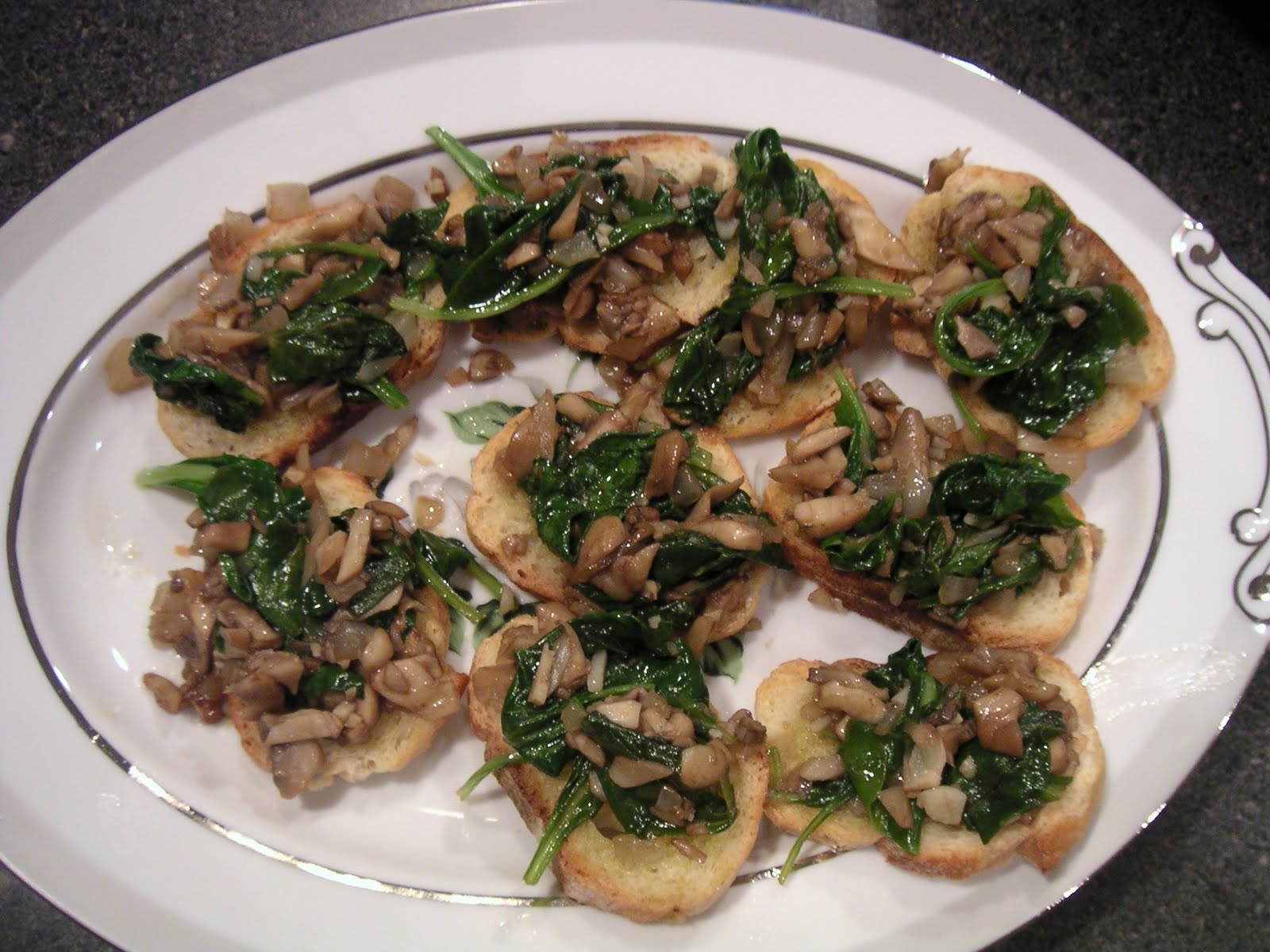
For dinner one night we made 3 different kinds of bruschetta.  (I'm not sure if they all classify as bruschetta, but I call it Bruschetta Night so please just go with it.)  All three options are vegan, although I did throw some fresh mozzarella on my traditional bruschetta.


Here's us slaving away while sipping wine. 

And here are the creations:
1.  traditional bruschetta with artichoke hearts, 
tomatoes, garlic, basil, and onions with balsamic vinegar and olive oil and
2. homemade hummus with marinated peppers

3.  sautéed mushrooms, onions, spinach, 
and garlic with balsamic vinegar and olive oil

All three were a big hit 
and earned a high five from my hubby.  
(One never knows when creatively cooking sans recipe.)
And now I'm a convert to homemade hummus-  
so easy and so much tastier.

PS:  I had my husband proofread this post, 
and he said his mouth started watering just looking at the photos.  
So I think it's a dinner I'll be making again soon 
(although sadly without Julia).

Thursday, April 29, 2010

My Husband is a Vegan Freak


Three months after our BBQ wedding, my husband came home from work one day and announced that he was going to be vegan.  Starting right then.  (For those of you who may not know, vegan means eating NO animal products.  No meat, no fish, no dairy, no eggs.)  Why and how he came to this life-altering decision is a story for another time- one my incredibly private husband has not yet given me permission to write about- but the short version is for ethical reasons.  The treatment of animals in our food supply is appalling.

His announcement was tough for me to handle, as I am a dietitian (and his wife!) and he did not consult with me before making this major decision.  Plus, many of my nutrition clients have disordered eating.  I've always promoted moderation and balance and the idea that "all foods fit."  And let's face it, veganism is a form of extreme eating.

I've had friends say, "I could never marry a vegan."  And my response is always, "I didn't."  My friends, you just never know what you are getting into when you say, "I do."

In the almost five years since we got married, I've gotten used to cooking vegan dinners.  But people are always asking (even my dietitian friends) what exactly do I make each night.  So for all of you who've asked and for those who are just curious, this post is for you.

For the past several months, I've been taking photos of our dinners.  I'll be posting photos of our vegetarian meals regularly.  And warning: I am not a food stylist but I swear that these meals look better in person than in these photos!

Here are three of our favorite vegan meals:

Black Bean Taco Night


Veggie Burger Night

We love Dr. Prager's California Style veggie burgers.  They don't contain any processed soy.  The soy veggie burger we like best is Morning Star Farms Vegan Grillers.  I cut up tons of fresh vegetables for toppings (even shaved carrots and avocado).  And we always use baby spinach instead of lettuce in our house.

Asian Night

Edamame, vegetable gyoza with lots of dipping sauces,
and Asian veggies.

PS:  I say "Vegan Freak" as a term of endearment.  He made this decision based on compassion for other living beings.  How could I not respect and support that?
PPS: I know people think vegans are freaks, because that is what we both thought before he became one!
PPPS:  I'm not vegan but a year or so after his conversion, I became a ovopescolactovegetarian (that's dietitian talk and means I still eat eggs, seafood, and dairy.)  
PPPS:  What are the odds?  My sister is married to a vegan freak too.

Saturday, December 5, 2009

Saved by a Pea

Last week I ran into a new friend who just started a business.  This former lawyer recently made a dramatic career change.  She's selling peas!  Not just any peas, but Peas for Prosperity.


I found the bit of history she shared fascinating and think you might too.  So here's a bit of nourishment for your mind:  


According to Southern tradition, eating black-eyed peas on New Year's Day will bring good luck and prosperity in the coming year.  The tradition began during the Civil War, when General William T. Sherman and his troops marched from Atlanta to Savannah, destroying everything in their wake.  Everything EXCEPT the black-eyed peas.  


The troops believed that cattle, not people, were the only ones who ate black-eyed peas.  After the war, black-eyed peas were the main source of food in the South.  The peas saved thousands from starvation and gave the South a second chance.  Since New Year's Day of 1866, the peas still represent regrowth.


This month, Christy started Peas for Prosperity.  A dollar from each bag of black-eyed peas sold will be donated to charities dedicated to helping people who need a second chance in life.  Visit her website to read her candid and inspiring personal story.


Here I am, purchasing my bags of Peas for Prosperity.  I think they'll make unique and meaningful hostess gifts.  And, I hold the distinct honor of being Christy's first customer!


On a final note: black-eyed peas are nutrition all-stars!  They're high in fiber and protein, and also good sources of folic acid, iron, and phytonutrients.  The Peas for Prosperity website has recipes on how to incorporate black-eyed peas into your diet.

Wednesday, November 18, 2009

Road Side Market


A few weeks ago, while driving to North Carolina's Outer Banks, my husband and I stumbled upon this road side market.  I love all farmer's markets, but this one was special.
  Look at the amazing way they display their produce!
Who doesn't want to buy a sand pail filled with apples or tomatoes?

Everything looked so pretty, I ran back to the car to get my camera.
It's easy to "eat a rainbow" when shopping at a farmer's market.

You can tell a lot about an area by what they choose to preserve.

Yes, that does say Tequila Jelly and Georgia Moonshine Jelly.

I've never heard of Purple Sweet Potato Butter before, but it sure sounds interesting.

You know you're in The South when Watermelon Rind Pickles are on the shelf.

Too bad this market isn't closer to our home.  I would be there weekly for sure!

ShareThis